
VO₂ Max: A Simple Metric That Says a Lot About How You’re Aging ♥️
There are a handful of things we tend to focus on when it comes to health—labs, hormones, inflammation, blood sugar.
All important.
But there’s another piece that quietly tells you how well your body is actually functioning day to day…
VO₂ max.
And most people have never even heard their number.
What VO₂ Max Really Reflects
VO₂ max is your body’s ability to take in oxygen and use it.
That sounds simple, but it reflects multiple systems working together:
your heart moving blood
your lungs bringing in oxygen
your muscles using it
your mitochondria producing energy
When those systems are working well together, you feel it—better energy, better endurance, better recovery.
Why This Matters for Longevity
This is where it gets interesting.
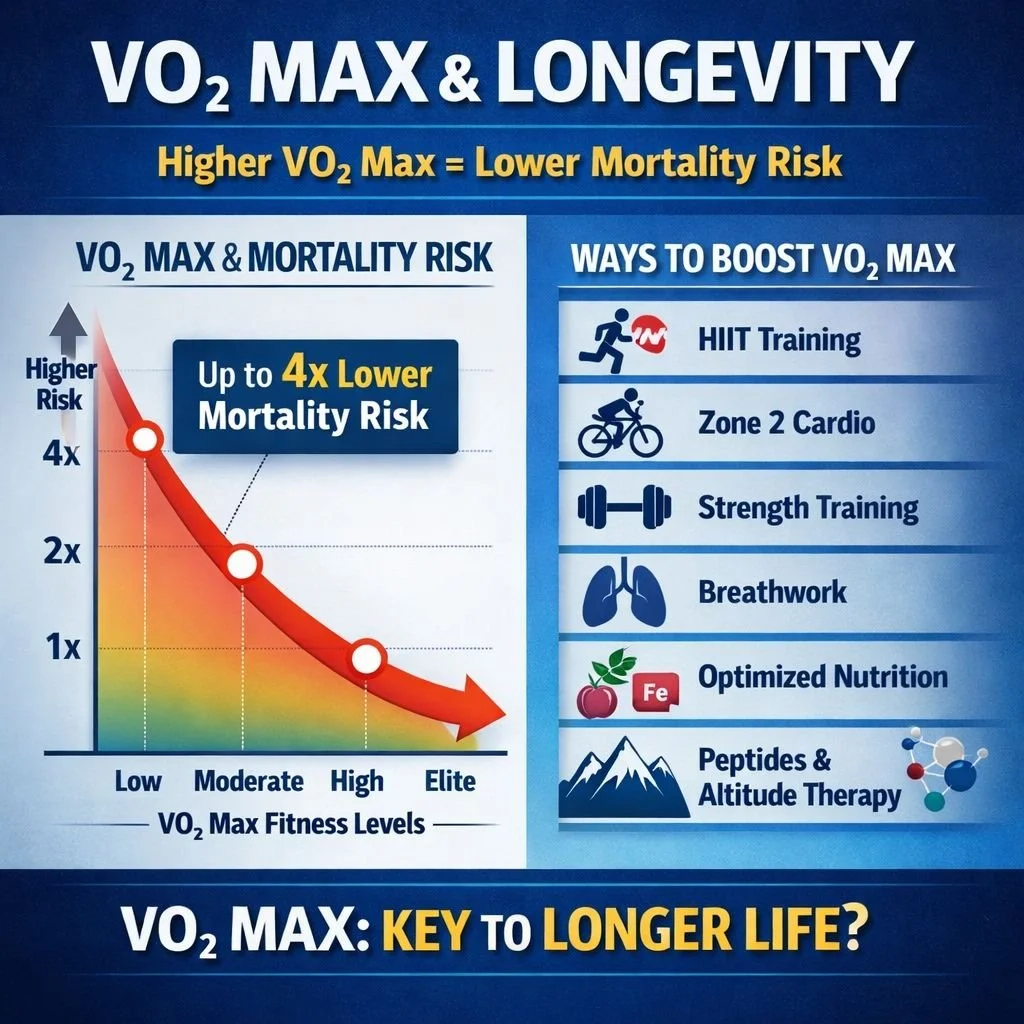
Research consistently shows that cardiorespiratory fitness is one of the strongest predictors of lifespan—not just for athletes, but across the general population.
In one large cohort study, higher fitness levels were strongly associated with lower long-term mortality, with elite fitness linked to significantly reduced risk compared to low fitness levels.
→ https://jamanetwork.com/journals/jamanetworkopen/fullarticle/2707428
Other research has reinforced that cardiorespiratory fitness should be considered a vital sign in clinical practice because of its strong relationship to health outcomes.
→ https://www.ahajournals.org/doi/10.1161/CIR.0000000000000461
And earlier work continues to support the same idea—higher fitness levels correlate with lower all-cause mortality.
→ https://jamanetwork.com/journals/jama/article-abstract/374182
When you step back and look at it, this isn’t tied to one lab marker.
It’s tied to how your body performs as a whole.
Where Most People Get Stuck
A lot of people assume they just need to work out harder or more often.
What tends to work better is a bit more structured—training different systems intentionally instead of doing the same type of workout over and over.
What Actually Improves VO₂ Max
High-Intensity Intervals
Short bursts of harder effort—done with intention—can move this fairly quickly.
A commonly studied protocol:
4 minutes hard effort
3 minutes recovery
repeat 4 times
a few times per week
This approach has been shown to improve VO₂ max more effectively than moderate continuous training in some studies.
→ https://pubmed.ncbi.nlm.nih.gov/17414804/
Longer, Steady Cardio (Zone 2)
This is the piece most people skip.
It doesn’t feel intense, but it builds the base—especially at the mitochondrial level.
steady pace
slightly challenging but sustainable
longer sessions
Over time, this improves how efficiently your body produces and uses energy.
Zone 2 isn’t flashy, but it’s the foundation. It’s the kind of training that improves mitochondrial function, fat burning, and overall efficiency—so when you do go hard, your body can actually handle it.
Here are real-life, doable ways to train in Zone 2—not just theory.
What Zone 2 Should Feel Like (Quick Check)
Before the examples, this is how you know you’re in the right zone:
You can talk in short sentences, but not hold a full conversation easily
Breathing is steady, not gasping
Effort feels like a 6–7 out of 10
You could sustain it for a while
If you’re wearing a tracker, it’s roughly 60–70% of max heart rate.
🚶♀️ Brisk Walking (Underrated + Powerful)
This is one of the easiest ways to stay consistent.
Make it effective by:
Walking at a pace that slightly pushes you
Adding hills or incline
Swinging arms with intention
Example:
45–60 minutes
Slightly breathy but controlled
3–5x per week
This alone can dramatically improve aerobic base if done consistently.
🚴♀️ Cycling (Outdoor or Stationary)
Great for longer sessions with less joint stress.
Example:
60–90 minutes
Steady cadence
Resistance moderate—not too easy, not crushing
This is ideal for building endurance without burnout.
🥾 Hiking (Especially with Incline)
Example:
60–120 minutes
Rolling hills or steady incline
Keep a pace where you’re working, but not stopping
Bonus: mentally grounding + you’ll actually want to do it again.
🏃♀️ Easy Jog / Run-Walk
Most people go too fast here.
Slow it down more than you think.
Example:
Jog 5–10 min, walk 1–2 min
Repeat for 45–60 minutes
The goal isn’t speed—it’s staying in the zone.
🚣♀️ Rowing (Low Impact + Full Body)
Great for full-body aerobic work.
Example:
30–45 minutes steady
Smooth, controlled strokes
Focus on rhythm, not power
🏊♀️ Swimming (If You Enjoy It)
Naturally keeps you in a steady aerobic zone.
Example:
Continuous laps
Controlled breathing
30–45 minutes
How to Structure It (Simple Weekly Rhythm)
You don’t need to overcomplicate this.
A realistic structure:
3–4 Zone 2 sessions/week
45–90 minutes each
Mix of walking, biking, hiking
Then layer in:
1–2 HIIT sessions (short + intentional)
2–3 strength sessions
What I See Work Best (Real Life)
The people who actually improve VO₂ max aren’t doing extreme workouts.
They’re:
consistent
not overtraining
building a base first
Zone 2 is where that happens.
One Simple Way to Start
If you want something actionable:
👉 Go for a 60-minute brisk walk with a few hills
👉 Keep your pace just slightly uncomfortable
👉 Do that 3–4 times this week
That alone is a strong start.
Strength Training
Strength training often gets separated from cardio, but it plays a role here too.
Improving muscle quality supports how well oxygen is used at the tissue level.
Simple, consistent compound movements go a long way.
Breathing & Oxygen Efficiency
Even breathing can be trained.
Improving respiratory muscle strength can support endurance and oxygen utilization—something that’s often overlooked but noticeable once you start paying attention.
Targeted Support: Peptides & Supplements That May Influence VO₂ Max
Once the basics are in place, there’s growing interest in supporting VO₂ max from a cellular level.
Not as shortcuts—but as support for systems that are already being trained.
NAD⁺ Support (Mitochondrial Energy)
NAD⁺ plays a central role in how your cells produce energy.
As levels decline with age, energy production and recovery tend to follow.
Supporting NAD⁺ through precursors like NMN and NR has been shown in human and preclinical research to improve mitochondrial function and metabolic health.
→ NMN human study: https://pubmed.ncbi.nlm.nih.gov/31248289/
→ NR metabolism study: https://www.nature.com/articles/ncomms12948
→ NMN clinical trial:https://science.sciencemag.org/content/372/6547/1224
Since VO₂ max ultimately comes down to how efficiently your mitochondria use oxygen, this connection matters.
MOTS-c (Metabolic Flexibility + Endurance)
MOTS-c is a mitochondrial-derived peptide that’s gaining attention in longevity research.
Early studies suggest it may improve exercise capacity and metabolic regulation.
→ https://www.cell.com/cell-metabolism/fulltext/S1550-4131(15)00300-3
This ties directly into how efficiently the body uses fuel during aerobic training.
BPC-157 (Recovery + Consistency)
BPC-157 is better known for injury recovery, but it may indirectly support VO₂ max by improving:
recovery time
tissue repair
training consistency
And consistency is what actually drives long-term improvements.
CoQ10 (Cellular Energy Production)
CoQ10 is essential for ATP production in mitochondria.
Lower levels are often associated with fatigue and reduced exercise tolerance.
Some studies show supplementation may support exercise performance and energy output.
→ https://pubmed.ncbi.nlm.nih.gov/18460985/
Dietary Nitrates (Efficiency + Blood Flow)
Foods like beets, arugula, and spinach contain nitrates that can improve:
blood flow
oxygen efficiency
exercise performance
→ https://pubmed.ncbi.nlm.nih.gov/30052625/
These are small inputs—but over time, they add up.
Iron Status (One of the Most Overlooked Factors)
Iron is essential for oxygen transport.
If levels are low, oxygen delivery drops—regardless of how well you train.
This is especially important in women and anyone dealing with fatigue.
Where This All Fits
You can’t rely on supplements or peptides alone to improve VO₂ max.
But you can support the systems that allow it to improve:
mitochondria
oxygen delivery
recovery
metabolic efficiency
When those are supported, your training actually translates into progress.
What I Think Is Worth Paying Attention To
VO₂ max gives you a different lens.
Not just numbers—but how your body actually performs.
Energy. Endurance. Recovery.
And maybe more importantly—it’s something you can improve over time.
A Question Worth Asking
Do you know your VO₂ max?
And if not—are you doing anything that would help improve it?
Closing Thought
This is where testing can be helpful—understanding things like iron status, mitochondrial support, and overall metabolic health—so you’re not guessing at what your body actually needs.
