
The Mouth-Body Connection: Why Oral Health Is More Important Than You Think 🦷
Most people think brushing their teeth is about avoiding cavities or keeping their breath fresh.
But it’s so much bigger than that.
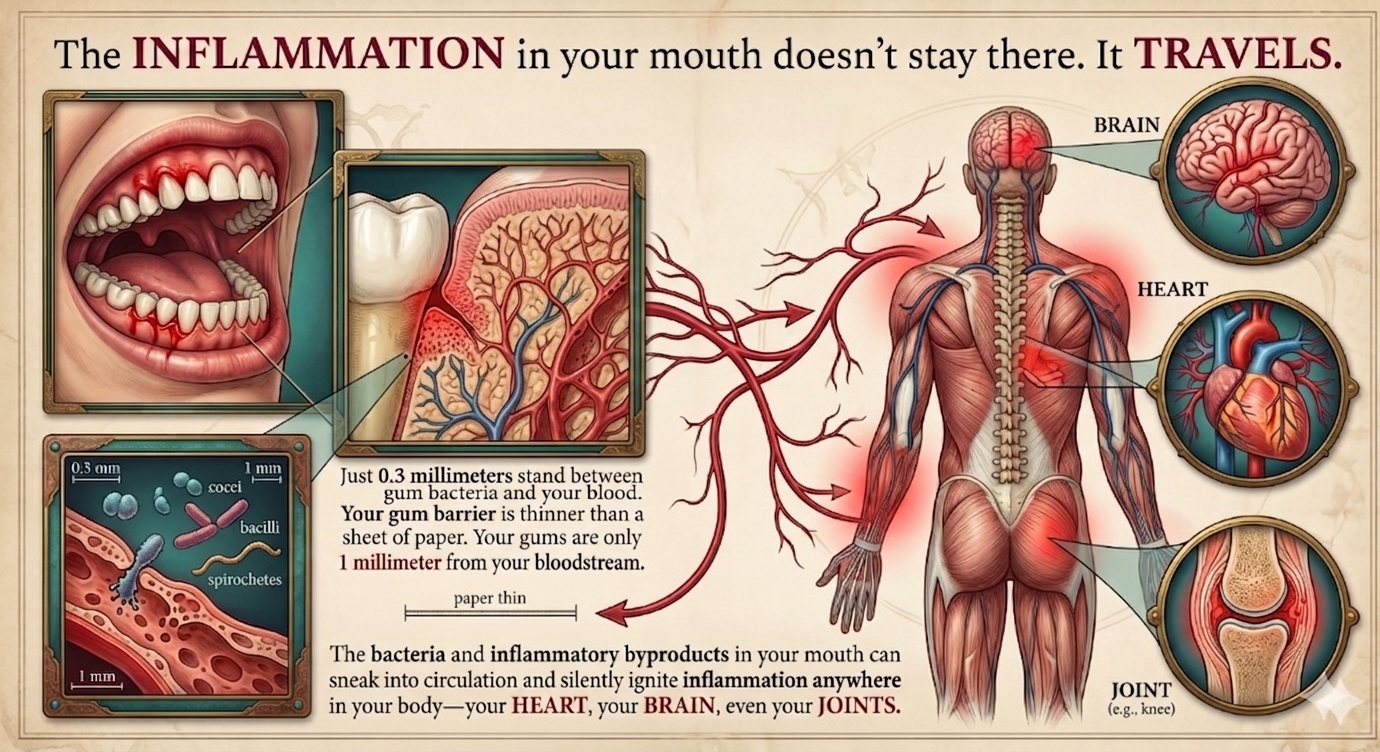
Your mouth is one of the primary entry points into your body—and what happens there doesn’t stay there.
It travels.
The Mouth Is Not Separate From the Body
There’s a very thin barrier between your gums and your bloodstream.
In healthy gums, that barrier is less than 0.3 mm thick—almost like a sheet of paper.
When inflammation is present (bleeding gums, tenderness, swelling), that barrier becomes even more permeable.
That means:
Bacteria
Toxins
Inflammatory compounds
…can move directly into circulation.
From there, they don’t just disappear—they contribute to inflammation in:
The heart
The brain
The joints
This is one of the reasons we see strong connections between oral health and conditions like cardiovascular disease, cognitive decline, and autoimmune issues.
Gum Disease Is More Common Than You Think
Nearly 46% of adults over 30 have some form of gum disease.
It often starts quietly:
Bleeding when brushing
Slight gum tenderness
Bad breath
Over time, it can progress into deeper pockets, bone loss, and even tooth loss if not addressed.
But the bigger concern is what’s happening systemically.
Chronic oral inflammation doesn’t just stay local—it contributes to overall inflammatory load in the body.
Your Oral Microbiome Matters
Your mouth has its own microbiome—just like your gut.
And just like your gut:
It needs balance
It thrives on the right environment
It gets disrupted easily
When the oral microbiome is out of balance (called dysbiosis), harmful bacteria take over and drive inflammation.
That imbalance can influence:
Gut health
Blood sugar regulation
Immune function
There’s a direct connection between the health of your mouth and the health of your gut.
Mouth Breathing vs. Nose Breathing (This Matters More Than You Think)
How you breathe plays a big role in oral health.
Breathing through your nose:
Filters air
Humidifies it
Produces nitric oxide
Why nitric oxide matters:
Nitric oxide helps with:
Blood vessel dilation
Oxygen delivery
Immune defense
Cardiovascular health
Your oral bacteria actually help produce nitric oxide from dietary nitrates.
But here’s the problem…
Mouthwash Can Disrupt This Process
Many conventional mouthwashes are antibacterial.
That might sound like a good thing—but it’s not.
They don’t just kill harmful bacteria.
They also wipe out the beneficial bacteria needed to produce nitric oxide.
Regular use has been linked to:
Higher blood pressure
Disrupted oral microbiome balance
This is why I don’t recommend daily use of conventional mouthwash unless it’s targeted and short-term.
How to Naturally Support Nitric Oxide
Instead of killing bacteria, we want to support the right ones.
Here’s how:
Eat nitrate-rich foods (beets, arugula, spinach)
Chew your food well (saliva matters)
Avoid overusing antibacterial mouthwash
Support your oral microbiome with diet and hygiene
Breathe through your nose (especially at night)
Mouth Taping at Night
This is one of the simplest habits that can make a big difference.
Mouth taping gently encourages nasal breathing while you sleep.
Benefits may include:
Better oxygenation
Improved sleep quality
Less dry mouth
Better oral microbiome balance
Dry mouth creates the perfect environment for harmful bacteria to grow.
Keeping the mouth closed helps protect that balance.
Toothpaste Matters More Than You Think
Most conventional toothpastes contain:
Fluoride
SLS (foaming agents)
Artificial ingredients
These can disrupt the oral microbiome.
A better approach:
Nano-hydroxyapatite (supports remineralization)
Non-toxic ingredients
Microbiome-friendly formulas
Your goal isn’t to sterilize your mouth—it’s to support balance.
What About Fluoride?
This is a controversial topic, but worth understanding.
Fluoride has been used to prevent cavities, but concerns exist around:
Neurotoxicity at higher exposures
Accumulation in the body
Potential effects on the pineal gland
There’s growing interest in alternatives like hydroxyapatite, which supports enamel without disrupting the microbiome.
Mercury Amalgams and Brain Health
Silver fillings (amalgams) contain mercury.
Over time, small amounts of mercury vapor can be released.
Mercury is a known neurotoxin and can impact:
Brain health
Nervous system function
ATSDR (Agency for Toxic Substances and Disease Registry) – Toxicological Profile for Mercury
This U.S. government resource confirms:
Mercury vapor is absorbed in lungs
Crosses into brain tissue
Can persist in the CNS
If someone is considering removal, it’s important to do this safely. I actually did this myself years ago and found a good dentist in Chicago to take mine out.
Look for trained biological or functional dentists through:
IAOMT (International Academy of Oral Medicine and Toxicology)
SMART-certified providers (Safe Mercury Amalgam Removal Technique)
Removal should never be done without proper protection protocols.
Nutrition Plays a Role Too
Oral health isn’t just about brushing.
It’s also about what you eat.
Supporting nutrients include:
Vitamin D
Vitamin C
Omega-3s
Magnesium
Zinc
Protein
A diet high in sugar and processed foods feeds harmful bacteria and drives plaque formation and inflammation.
Peptides and Oral Health
This is an area that’s starting to get more attention.
Some peptides that may support healing and inflammation include:
BPC-157
Supports tissue repair
May help with gum healing and inflammation
GHK-Cu
Supports collagen production
May support gum and tissue regeneration
Thymosin Beta-4 (TB-500)
Supports healing and cellular repair
These are not replacements for good oral hygiene—but can be supportive tools in the right context.
Simple Daily Foundations
If you’re looking to simplify all of this, start here:
Brush twice daily (especially before bed) - I like this electrical toothbrush
Use a tongue scraper
Choose a non-toxic toothpaste
Avoid daily antibacterial mouthwash
Eat whole, nutrient-dense foods
Breathe through your nose
Stay hydrated
One of my favorite functional dentists to follow is Dr. Mark Burhenne with Ask The Dentist - he has a lot of amazing resources.

Final Thought
Oral health isn’t just about your teeth.
It’s about inflammation.
It’s about your microbiome.
It’s about your heart, your brain, and your long-term health.
It’s one of the most overlooked foundations—and one of the easiest places to start.
